
Two words that get used for the same invoice
A company of 60 people asks for "digital transformation" and describes, on the call, a spreadsheet that three people update by hand every Monday. Another company asks for "automation" and describes four tools that do not talk to each other, a reporting process nobody trusts and a founder who approves every order personally. The first needs automation. The second needs transformation. The words were swapped, and the wrong word buys the wrong project.
The distinction matters because the two kinds of work have different scope, different risk and different owners. Getting it right at the start is the cheapest decision in the whole engagement.
What process automation is
Process automation takes a process that already works when people run it and removes the manual steps: re-typing data from one tool into another, sending the same email with three fields changed, checking a list against another list, moving a file to the right folder. The process, its inputs and its outputs stay the same. The effort drops. When the re-typing sits between the ERP, the CRM and a spreadsheet, the fix is usually an ERP-CRM integration, not a new platform.
Good candidates share four traits: the process is repeated often, the rules are explicit, the exceptions are rare and known, and the data is already in a system. If any of those is missing, automation will either break on the first exception or automate a mess.
What digital transformation is
Digital transformation changes the operating model. It replaces the tools, connects the data, redraws who decides what, and often removes whole process steps rather than speeding them up. A merch company that moves from email orders and a spreadsheet catalogue to a platform where clients configure and order themselves has not automated its order process. It has replaced it with a different one, in which the customer does part of the work and the team does none of the re-typing.
Transformation touches structure: roles, permissions, what "done" means, how numbers are produced. That is why it needs the owner in the room and why it cannot be delegated to a tool.
Side by side
| Process automation | Digital transformation | |
|---|---|---|
| Question it answers | How do we do this task with less manual effort? | How should the company run so that this task is smaller or gone? |
| Scope | One process or one hand-off | A function, a value chain or the whole company |
| What changes | Effort per task | Systems, data flows, roles and decisions |
| Precondition | A defined, working process with data in a system | A clear picture of the target operating model and a sponsor who owns it |
| Typical tools | Workflow tools, scripts, integrations, AI workflows | Platforms, integrations, data models, new interfaces |
| Duration | Weeks | Months, delivered in stages |
| Risk if done alone | Automating a broken process, faster | A long programme with no early wins |
| Measured by | Hours saved, error rate, cycle time per task | Output per person, lead time, revenue the old model could not carry |
When to automate a process
Automate when you can say the following sentence without hesitating: "This process works, we do it more than twenty times a week, the rules are written down, and the data is already in a system." If the sentence is true, automation pays back fast and carries little risk.
Do not automate yet when the process changes every quarter, when nobody can list the exceptions, or when the inputs live in chat threads and people's heads. That is a normal place to start, not a dead end. The useful first work is process optimization: bring the inputs into one structured place, define the process, remove the steps that should not exist, then automate what remains. Our process optimization service exists for exactly this case.
When digital transformation is the right project
- Growth has outrun the tools: the spreadsheet that held the company at 15 people breaks it at 60.
- Every decision routes through one person, because the systems cannot carry the rules.
- Data is re-entered between tools, and the reports built from it are not trusted.
- A new channel, market or product line does not fit the current operating model at all.
- A hiring plan is being used to solve a systems problem.
The public data says the transformation layer is where Romanian companies fall behind. In 2024, 69.1% of Romanian SMEs had at least a basic level of digital intensity, close to the EU average of 72.9%. But only 21.69% reached a high or very high level, against 32.66% in the EU, and just 15.52% of Romanian enterprises bought cloud services in 2023 against 38.97% in the EU (European Commission, Romania 2025 Digital Decade Country Report, 16 June 2025). Basic tools are there. Connected systems are not. That is what transformation builds, and what our digital transformation service designs and builds for companies of 10 to 250 people.
The order that works
- Diagnose. Map the processes that matter and find where time, errors and decisions pile up. Two weeks, with the owner.
- Fix the process on paper. Remove the steps that exist only because a tool cannot do something. This is process optimization, and it is free of software.
- Automate the stable parts. Quick, bounded, measurable. This buys trust and time for the larger work.
- Transform where the process cannot be fixed inside the current systems. Build or replace the platform, connect the data, hand over the rules to the software.
- Automate again on top of the new system, including AI workflows where they earn their place.
Starting at step 4 is the classic mistake: a long programme, no early results, and a team that stops believing in it by month six. Starting at step 3 and staying there is the other one: dozens of automations on top of tools that should have been replaced, each one fragile in its own way. If funding is part of the question, digitalization with or without PNRR covers where to start either way.
A worked example
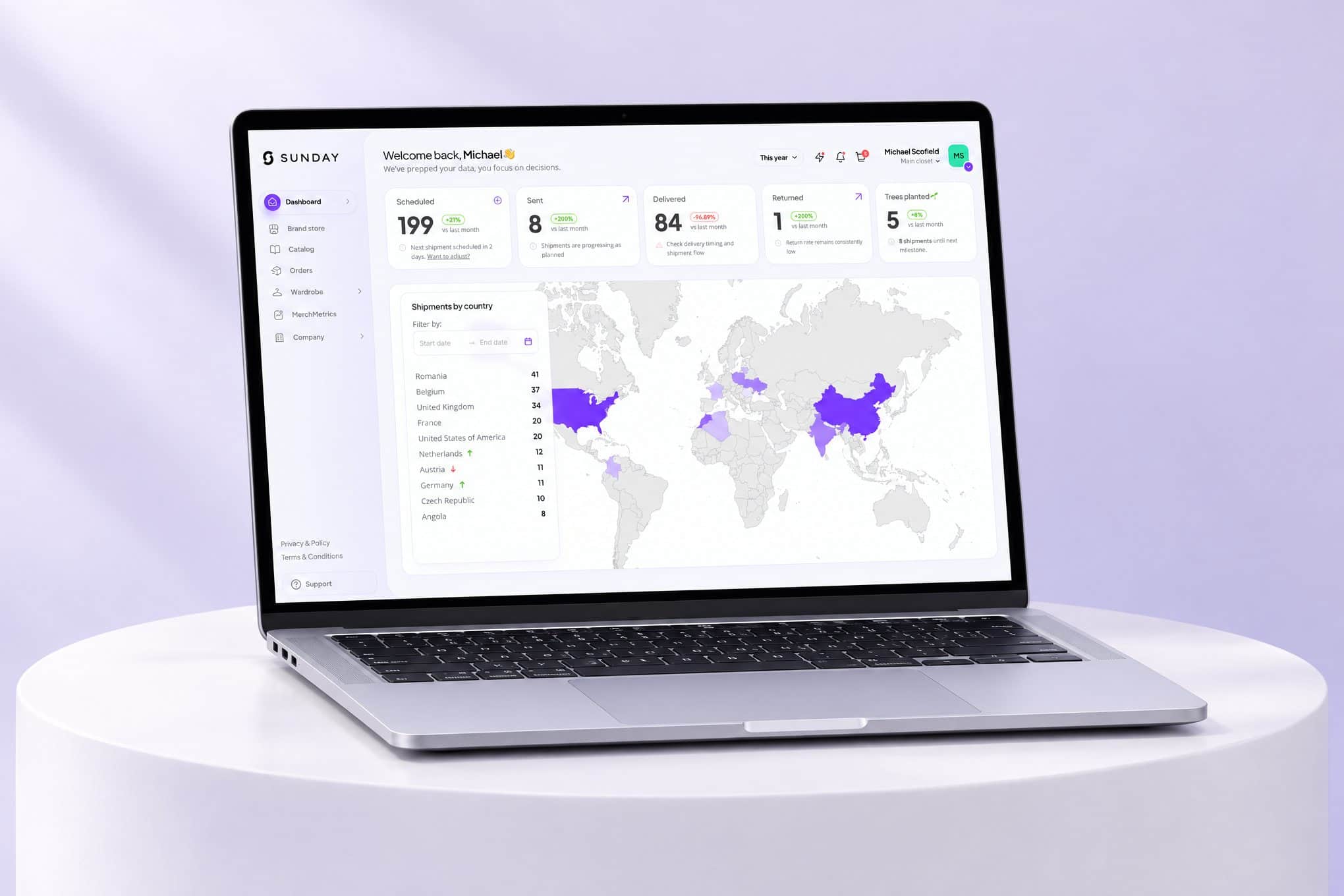
Our work on Sunday's B2B application followed that order. Sunday is a branded merchandise platform that ships to 200+ countries, and its business customers run their merchandise programs in one application. Before designing a single screen, we mapped the flows and processes the application had to carry; only then did we design the UX and UI around them. That sequence is the difference between putting a new interface on top of the old way of working and changing the way of working itself. Automations added later sit on a process that has been thought through, not on one that was copied. The Sunday B2B case study describes the approach.
Summary
- Automation reduces effort inside a process that works. Transformation changes how the company works.
- Automate when the process is stable, frequent, rule-based and already in a system.
- Transform when growth has outrun the tools and decisions cannot leave one person's desk.
- Sequence: diagnose, fix the process, automate the stable parts, transform what the tools cannot carry, automate again.