Hotels and tourism
Digital transformation for
hotels and tourism
Requests for conferences, weddings, groups and the SPA arrive by email, phone and WhatsApp, and each quote is written by hand after a long back and forth. We build the applications your customers use to request a quote, a SPA appointment or a place on a package on their own, then connect them to the hotel software you already run. Room bookings stay in your booking engine.
Murarum is a studio based in Iași, Romania, that digitalizes hotels, venues with event halls and a SPA, guesthouses and travel agencies. We build the applications where customers request quotes for conferences, weddings and groups, book SPA treatments or pre-book a package on their own, with their documents and payments in their account. Behind them, every request lands in one place, connected to the hotel software (PMS), the channel manager and e-Factura. We do not replace the booking engine or the PMS. We typically work with companies of 10 to 250 people, and fit depends on how complex the requests are, not on headcount. Every project starts with a diagnosis.
We reply within two working days. The first conversation is about how requests reach you today, not about technology.
Sound familiar?
Rooms are booked online.
Every other request arrives on every channel.
Situations we hear about from hotels with conference rooms, venues with a SPA and weddings, and travel agencies. If two of them sound familiar, it is worth a conversation.
"Could you send us a quote for a conference?"
The request arrives by email, each in a different format: a date, "about 80 people", no room layout and no number of rooms. Days and many messages pass before the quote goes out.
Nobody sees everything that came in.
Rooms, SPA, weddings, catering, by email, phone and WhatsApp, handled by different people. A wedding request forgotten on WhatsApp is a lost event.
The rooming list travels around in a spreadsheet.
The organizer sends the list, then a new version, then another. Reception types it into the hotel software and corrects it at every change.
SPA appointments are phone-only.
In the evening and at weekends, when guests want to book a massage or a package, nobody picks up.
In season, the agency phone never stops.
Each booking is written 2-3 times: in a notebook or spreadsheet, in the contract, on the invoice and on the coach list. The seats left on a tour are tracked by hand.
The deposit is hunted down in the bank statement.
The proforma goes out by email, the proof of payment comes back on another email, and accounting matches them by hand.
If two or three of these sound familiar, you don't need different hotel software. You need the requests that don't fit in it to follow a clear path, from the first message to the invoice.
For your customers
Customers request the quote on their own.
Your team reviews and confirms.
Applications for the requests that have no place of their own today: events, groups, the SPA and packages. We don't build them all at once: the diagnosis shows which one to start with.
An event request with a prepared quote is a form where the organizer picks the date, the number of participants, the room and the services, and the sales team receives a quote calculated from the hotel's rates and packages, which they review and send.
- 01
Event and conference requests, with a prepared quote.
The form asks for exactly what you need: the date, the number of participants, the room layout, coffee breaks, meals and rooms. The quote is prepared from your rates and packages, and the event manager reviews and sends it. For weddings, the package and the menu are chosen in the same place, not in a PDF sent over WhatsApp.
- 02
Group and corporate requests.
Companies you work with often have their own account, with their negotiated rate, history and contact person. A new request starts from the last one, not from scratch.
- 03
SPA and treatment booking.
Guests see the free slots, pick the treatment or package and get a confirmation, in the evening and at weekends too. Reception sees the appointments in the same list.
- 04
A package and offer catalog, with pre-booking.
For travel agencies and tour operators: tours, holidays and pilgrimages, with the remaining seats kept current. A pre-booking holds the seat until the deposit arrives. For hotels: weekend, SPA or holiday packages.
- 05
The customer's account, with their documents.
The quote, the contract, the proforma, the rooming list and the event program, in one place. The organizer uploads the rooming list and edits it on their own, and your team sees what changed.
- 06
Online payment or deposit.
If you want, the customer pays the deposit for an event or a package straight from the account, through the payment processor you work with. Payment status is visible without anyone searching the bank statement.
Room bookings stay in the booking engine and the hotel software (PMS) you already have. We don't replace them: we build what they don't cover, the requests that arrive today by email, phone and WhatsApp, and connect them to it.
The phone stays for customers who prefer to call, but their request is entered only once too. The applications can be in Romanian and English, for organizers and guests from abroad.
Inside your company
What happens once the request is in.
Each process has its own page, with an illustrative example, risks and questions.
Today and after
A conference request at a hotel, from the first email to the rooming list.
An example written for this page, not a client: a hotel with conference rooms, a SPA and a restaurant that receives event requests from companies and organizers.
Illustrative example
Today
The request arrives at the events email address. By hand
A date and a rough headcount, with no room layout and no rooms.
Sales asks for the missing details. By hand
Another email, another call.
The quote is written in Word, from the rates in a spreadsheet. By hand
And rewritten when the number of participants changes.
The rooming list arrives as a spreadsheet, in several versions. By hand
Reception types it into the hotel software and corrects it with every version.
The deposit is hunted down in the bank statement. By hand
The proforma went out on one email, the proof of payment comes back on another.
The request passes through several people and several inboxes before it becomes a confirmed event.
After
The organizer fills in the request on the website. The app
Date, participants, room layout, coffee breaks, meals and rooms.
The quote is prepared from your rates and packages. The app
The room, the per-participant package and the rooms, calculated by the hotel's rules.
The event manager reviews and sends the quote. Team checks
Special cases reach them with the reason written down.
The organizer uploads the rooming list to their account. The app
Changes show right away, and reception gets the list ready for the hotel software.
The deposit is paid online or against the proforma. The app
Payment status shows in the account, for the organizer and for your team.
One step stays with a person: reviewing the quote. The organizer sees the quote, the contract, the proforma and the rooming list in one place.
The same pattern, in other situations (illustrative examples)
Weddings and private events
The couple picks the date, the number of guests, the package and the menu, and the event manager gets a prepared quote instead of a message thread. The deposit and the contract show in the account.
SPA and treatments
Booking happens online, on the free slots, with the chosen treatment or package. SPA packages with accommodation come from the same catalog.
Travel agency or tour operator
The traveler picks a tour from the catalog, sees the remaining seats and pre-books with a deposit. The travel contract and the coach list are filled in from the same booking, once.
Groups and corporate requests
A company asks for rooms for a team at its negotiated rate. The rooming list is filled in on its account, and the invoice goes to the company.
Gyms and clubs
For memberships and class bookings, subscription software is often enough. Then we don't build anything from scratch: we connect it to payments and accounting.
What you already have
Keep your hotel software.
We connect to it.
Your hotel software (PMS)
Stays the source for rooms, rates and occupancy. We connect to it through an API or file imports and exports. For agencies, the same goes for the booking software you already use. Which kind of connection your software supports, we check in the diagnosis.
Your booking engine and channel manager
Stay. Room bookings from your website and from online booking platforms work as they do today. We work on the requests they don't cover: events, groups, the SPA, packages.
Your invoicing software and e-Factura
Receive the proforma and the invoice from the confirmed quote, with no second entry.
Your existing website
The event form, SPA booking or package catalog is added to the website you have, or lives at a separate address linked from it. You don't need to rebuild the website to start.
Email, Excel and WhatsApp
Are nothing to be embarrassed about. They are the real map of how the team works today and the point we start from: the messages show what customers ask, and the spreadsheets show how you price a quote.
Your IT team and your hotel software provider
If you have an IT team, it works with us from the diagnosis on. We talk to your PMS provider directly about how to connect. If you don't have IT, that's not a requirement.
Case study
The other side of the same event: Eventer.NET.
We don't have a published hotel case study yet. What we do have is the project closest to a hotel's events: Eventer.NET, a company based in Iași, organizes medical congresses and scientific events, the kind of client a conference hotel receives.
Each speaker's travel, accommodation and documents used to be collected over email and spreadsheets, and every agenda was put together by hand. We built the platform that changed that process: speakers complete their own details in Romanian or English, the team reviews what comes in from one back-office, and organizers see at a glance who still has something to send. The platform is in production. We did the analysis, prototype, design, application and API.
The same mechanism, at a hotel's events
| At Eventer.NET | At a hotel with events |
|---|---|
| Speakers complete their own travel, accommodation and documents, in Romanian or English | The organizer or the couple fills in the request on their own: date, participants, room, menu and rooms |
| The team reviews what came in from one back-office, instead of collecting and copying it | The events team reviews requests from one place, not from email, phone and WhatsApp |
| Each speaker's agenda follows the program when it changes | The quote, the proforma and the rooming list follow the request when the number of participants changes |
| Organizers see at a glance who still has something to send | You see at a glance which quotes are waiting, which deposits haven't arrived and which rooming lists are missing |
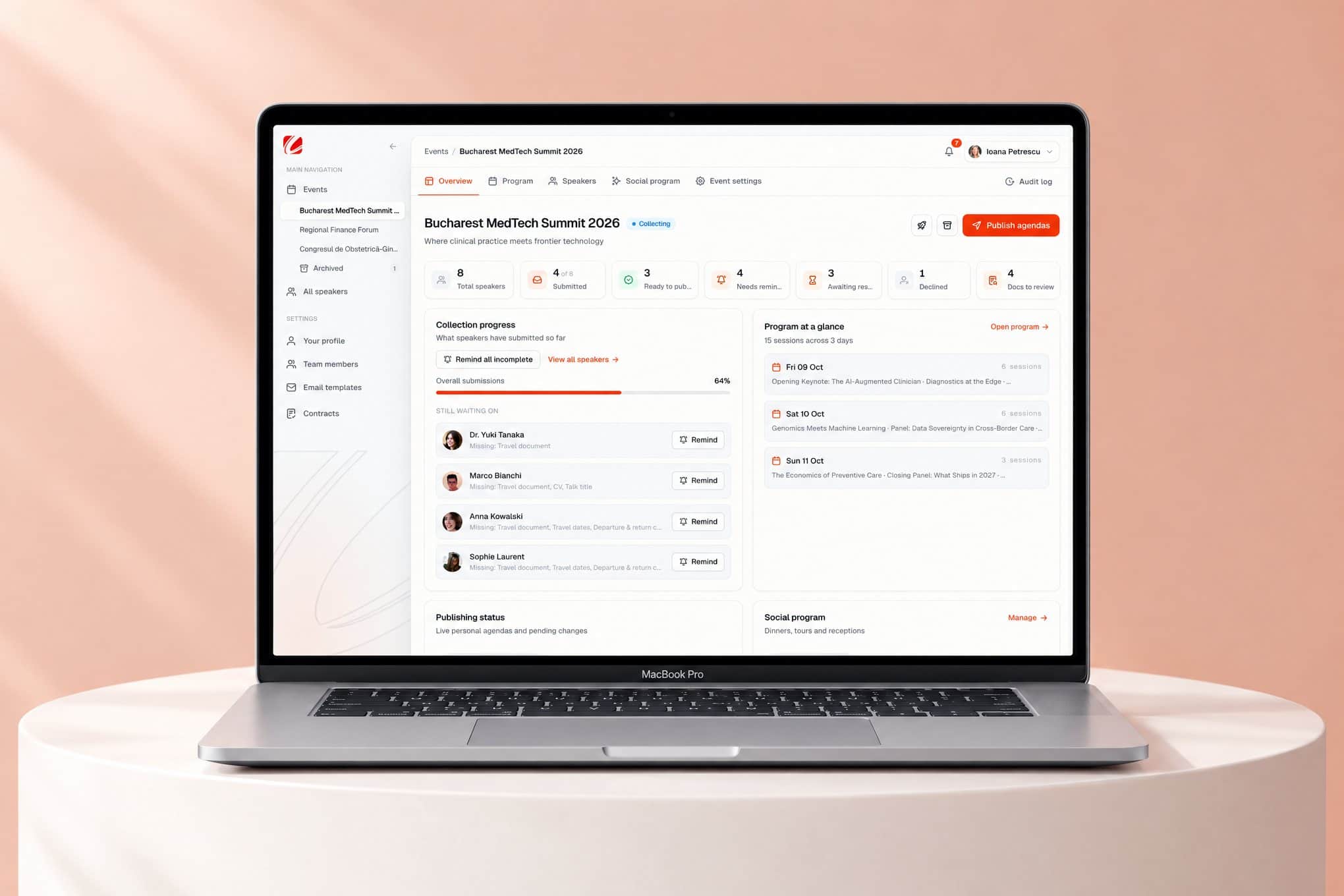
The conference example above is illustrative. We publish a real project's figures only with the client's approval.
How we start
We start with the diagnosis.
The diagnosis is the first step of every Murarum project. For a hotel or a travel agency, it means we follow a few dozen real requests, from the customer's first message to the contract, the deposit and the invoice, and write down what is worth changing first. We write no code during the diagnosis.
What you get
- A map of how a request travels today, per channel: email, phone, WhatsApp, form, reception.
- Baseline figures measured on your requests: volume per request type, time to quote, messages exchanged and retyping.
- A ranked list of changes, with the reasoning for each. For example, event requests before SPA booking, or the other way around.
- A written plan, with a proposal if you want us to build it. The diagnosis is yours, and you can act on it without us. If an off-the-shelf product fits better, we write that down.
What we need from you
- A few hours with the people who answer requests: sales or events, reception, the SPA.
- A few real requests, from email or WhatsApp, and access to the hotel software or an export.
- One person who can say yes or no.
How long it takes
From a few days to 2 weeks, depending on how many request types (events, groups, SPA, packages) and teams we look at. If your company is in Moldova, north-eastern Romania, we come to your offices for the diagnosis.
If you already know what you want to build
The diagnosis gets shorter, for example 2-3 days on a single flow: event requests with a prepared quote, or the package catalog with pre-booking.
"Wedding and conference requests arrive on three channels and need several rounds of messages before a quote. We start with the event form and the prepared quote, and leave SPA booking for phase two."
We do not write grant applications. If you already have funding, the plan from the diagnosis can serve as the technical basis.
Digitalization With or Without PNRRQuestions about digital transformation for hotels and travel agencies
Do you replace our booking engine or hotel software?
No. Room bookings stay in the booking engine, the channel manager and the hotel software (PMS) you already have. We build what they don't cover: event, group and SPA requests, packages and the customer's documents, and connect them to it.
Can you connect to our hotel software and channel manager?
Yes, if the software has a way in: an API or file imports and exports. Tell us which software you use and we'll tell you in the first conversation which kind of connection it supports. We check the technical details in the diagnosis, on your system, and talk to the provider directly if needed.
ERP-CRM IntegrationWhy not off-the-shelf software or a booking engine on a subscription?
For room bookings, an off-the-shelf booking engine is the right choice, and you probably have one already. Likewise, for simple SPA appointments or gym memberships, subscription software is often enough, and we can connect it to payments and accounting. We build custom software when requests don't fit a template: events with packages and room blocks, negotiated rates for groups and companies, rooming lists that keep changing, tours with seats and deposits. Then the application and the code are yours, with no per-user license. We compare the cost over several years, not just the cost to get started.
Freelancer, Agency, SaaS or Studio?Do we need to rebuild our website?
No. The event form, SPA booking or package catalog is added to the website you have, or lives at a separate address linked from it. The room booking button stays connected to your booking engine.
Can customers pay online or leave a deposit?
Yes, if you want. The deposit for an event, a package or a pre-booking can be paid from the customer's account, through the payment processor you work with. The payment shows on the request, and the proforma and invoice come from the same data.
Is guest and participant data safe?
Yes. Access to rooming lists, contracts and payment details is limited to the people who need it, and data is stored on your servers or in the cloud, in EU data centers. We sign a mutual NDA before we see anything and a data processing agreement for any data we can access. Each customer sees only their own requests and documents.
How long does it take and how much does it cost?
The diagnosis takes from a few days to 2 weeks. We put the build timeline in the proposal after the diagnosis, depending on how many request types and integrations it covers. We ship in stages: one part goes live before we start the next. We don't publish a price list: the price of the diagnosis is agreed in writing before we start, and the build has a fixed price, based on the plan from the diagnosis.
How We PriceWho owns what you build?
You do. The code, the repository and the documentation are yours from the first commit, with no license and no dependence on us. Any bug that appears after launch is covered by a 12-month warranty.
Do you work with hotels and agencies in Iași?
Yes. We are based in Iași, Romania, and work with companies across Romania and the European Union. For companies in Moldova, north-eastern Romania, we come to your offices for the diagnosis. The rest of the work usually runs remotely.
Other industries
The same method, in other sectors.
Tell us how an event or group request reaches you today.
Which kinds of requests you get, which channels they arrive on and who answers them.
We reply within two working days and tell you honestly whether a diagnosis is worth it and what it would cover. We usually work with hotels, venues and travel agencies of 10 to 250 people. How many kinds of requests you get, and how complex they are, matters more than your headcount.