Healthcare clinics
Digital transformation for
healthcare clinics
Patients call to book, reception writes it down, confirms it and types the same details into several programs, and the slot freed by a no-show stays empty. We make sure your patients can book and follow their treatment on their own, and that the data reaches your practice software without retyping.
Murarum is a studio based in Iași, Romania, that digitalizes private healthcare clinics: dental, outpatient polyclinics, fertility, rehabilitation and physiotherapy. We build online booking per doctor and location, reminders, session packages, patient journeys with steps and documents, and occupational health requests for employers, connected to the practice software the clinic already uses. We do not sell or replace the practice software. The clinic remains the controller of patient data, and we act as its processor. We typically work with clinics of 10 to 250 people, and every project starts with a diagnosis.
We reply within two working days. The first conversation is about how appointments reach you today, not about technology.
Sound familiar?
An ordinary day at a clinic's front desk.
The front desk phone never stops ringing.
Appointments come in by phone, from the website form, on Facebook and on WhatsApp. Reception writes them down, confirms them one by one and types them into the practice software.
Every location has its own calendar.
The patient calls one clinic, but the doctor has a free slot tomorrow at the other. Reception checks two programs or calls a colleague.
Slots lost to no-shows.
The patient forgot, or had no way to cancel without calling, and the slot stayed empty.
Session packages are tracked on paper or in Excel.
How many sessions the patient has had, how many are left, what has been paid. At every booking someone counts again.
Patients get lost on a long journey.
In a fertility or rehabilitation program, or a dental treatment plan, the steps, tests and payments are explained over the phone, every time. The patient doesn't know what comes next and calls to ask.
The same details, written three times.
The paper form filled in in the waiting room, the referral, the data for reporting to the health insurance house (CAS), the invoice. Reception enters them by hand, in different programs.
If two or three of these sound familiar, you don't need new practice software. You need patients to do their part on their own, and the data to reach the software you have without anyone typing it in.
For your patients
Patients book on their own.
Reception has time for the people in front of it.
Applications your patients and the employers you work with use, connected to your practice software. We don't build them all at once: the diagnosis shows which one to start with.
- 01
Online booking per doctor, specialty and location.
One calendar for all your clinics. The patient picks the doctor or therapist, the location and a free slot, and the appointment goes into the practice software. For services covered by CAS, the patient uploads the referral when booking, and reception checks it.
- 02
Confirmations, reminders and cancelling from the message.
The patient gets a confirmation and a reminder before the visit, by SMS, email or WhatsApp, and can cancel or move the appointment without calling. The freed slot shows in the calendar right away.
- 03
Session packages and subscriptions.
The patient buys the package, sees how many sessions are done and how many are left, and books the next one on their own. Reception stops counting on paper.
- 04
The patient journey, step by step.
For long programs, such as fertility, rehabilitation or a dental treatment plan: the steps, what to do before each one, the documents and the payments, in one place. The patient knows what comes next, and the team sees who has fallen behind.
- 05
Forms before the visit, results and documents in the account.
The medical history form and consents are completed at home, not on paper in the waiting room. After the visit, the patient finds results, the medical letter and the invoice in their account. If you want, they can pay online, right from the account.
- 06
Occupational health requests from employers.
The company sends the list of employees and the type of exam, gets grouped appointments and sees the fitness-for-work certificates in its own account. No quotes and lists traded over the phone.
The phone and reception stay. Patients who prefer to call can keep calling, and appointments made by phone go into the same calendar. Your existing website stays too: booking is added to it or lives at a separate address, linked from the site.
Inside your clinic
What happens once the patient has booked.
Each process has its own page, with an illustrative example, risks and questions.
Today and after
A rehabilitation center with two locations, today and after.
An example written for this page, not a client.
Illustrative example
Today
The patient calls to book. By hand
Reception looks for a free therapist across two calendars.
A 10-session package is noted on a paper card. By hand
The payment is entered separately, in the invoicing software.
For every session, the patient calls again. By hand
A no-show is noticed only at the appointment time. By hand
The slot stays empty.
Nobody notices when a patient drops out halfway through treatment. By hand
Every session goes through a phone, a paper card and a keyboard. Reception counts sessions instead of welcoming patients.
After
The patient buys the package online or at reception. The app
It shows in their account, with the sessions left.
They book their sessions from the account. The app
With the therapist and at the location they choose, in the shared calendar.
They get a reminder the day before. The app
And can move the session right from the message.
The invoice comes from the package and goes to e-Factura. The app
Reception sees the patients who stopped booking sessions. Reception checks
It calls them, not everyone.
Therapists see the day's schedule. The patient sees how many sessions are left. Reception calls only where it matters.
The same logic in other clinics (illustrative examples)
A group of dental clinics
One calendar per dentist and treatment room, across all locations. The treatment plan in the patient's account, with its stages and payments.
A fertility clinic
The journey in steps: consultations, tests, procedures and payments. The patient sees what comes next and which documents to bring, without calling for every question.
A polyclinic contracted with CAS
Booking by specialty, with the referral uploaded at booking. Occupational health requests from employers follow a separate flow, with grouped appointments.
What you already have
Keep your practice software.
Get more out of it.
Your practice or clinic software
Stays the source for patients, records, appointments and services. We connect to it the way we connect to an ERP: through an API, file imports and exports, or database access. We replace it only if it cannot be connected at all, and that decision is made in the diagnosis, with the cost of both options on the table.
Your lab software
Results reach the patient's account from the program that produces them, after the validation step the clinic sets, not from emails with attachments.
Reporting to CAS
Stays in the program that does it today. We feed it the data from appointments and services, so nobody enters it a second time.
Your invoicing software and e-Factura
Receive the invoice from the completed appointment or the package sold, with no second entry.
Patient data
Stays the clinic's. The clinic is the data controller, and we act as its processor under a data processing agreement. Data is hosted in EU data centers, access is limited and logged, and we carry out the data protection impact assessment (DPIA) together with the clinic, before launch.
Your IT team or software vendor
If you have an IT team, or your practice software vendor has a technical contact, they work with us from the diagnosis on. If not, that's not a requirement.
Proof
The same pattern, already in production.
We don't have a published case study with a clinic and patient data yet. What we do have is the pattern a patient journey needs: people outside the organization complete their own details and documents, the team reviews from one place, and the status is visible at a glance.
Eventer.NET, a company based in Iași, organizes medical congresses and scientific events. Each speaker's travel, accommodation and documents used to be collected over email and spreadsheets. We built the platform that changed that process: speakers complete their own details in Romanian or English, the team reviews what comes in from one back-office, and organizers see at a glance who still has something to send. Speakers share personal documents, so privacy and access control were part of the design from the start. The platform is in production. We did the analysis, prototype, design, application and API.
The same mechanism, in a clinic
| At Eventer.NET | In a clinic |
|---|---|
| Speakers complete their own details and documents, in Romanian or English | Patients complete their own forms and upload the referral, before the visit |
| The team reviews what came in from one back-office | Reception reviews what the patient sent, instead of typing it |
| Each speaker's agenda follows the program when it changes | The patient journey follows the doctor's plan when it changes |
| Organizers see who still has something to send | The team sees at a glance which patients have fallen behind |
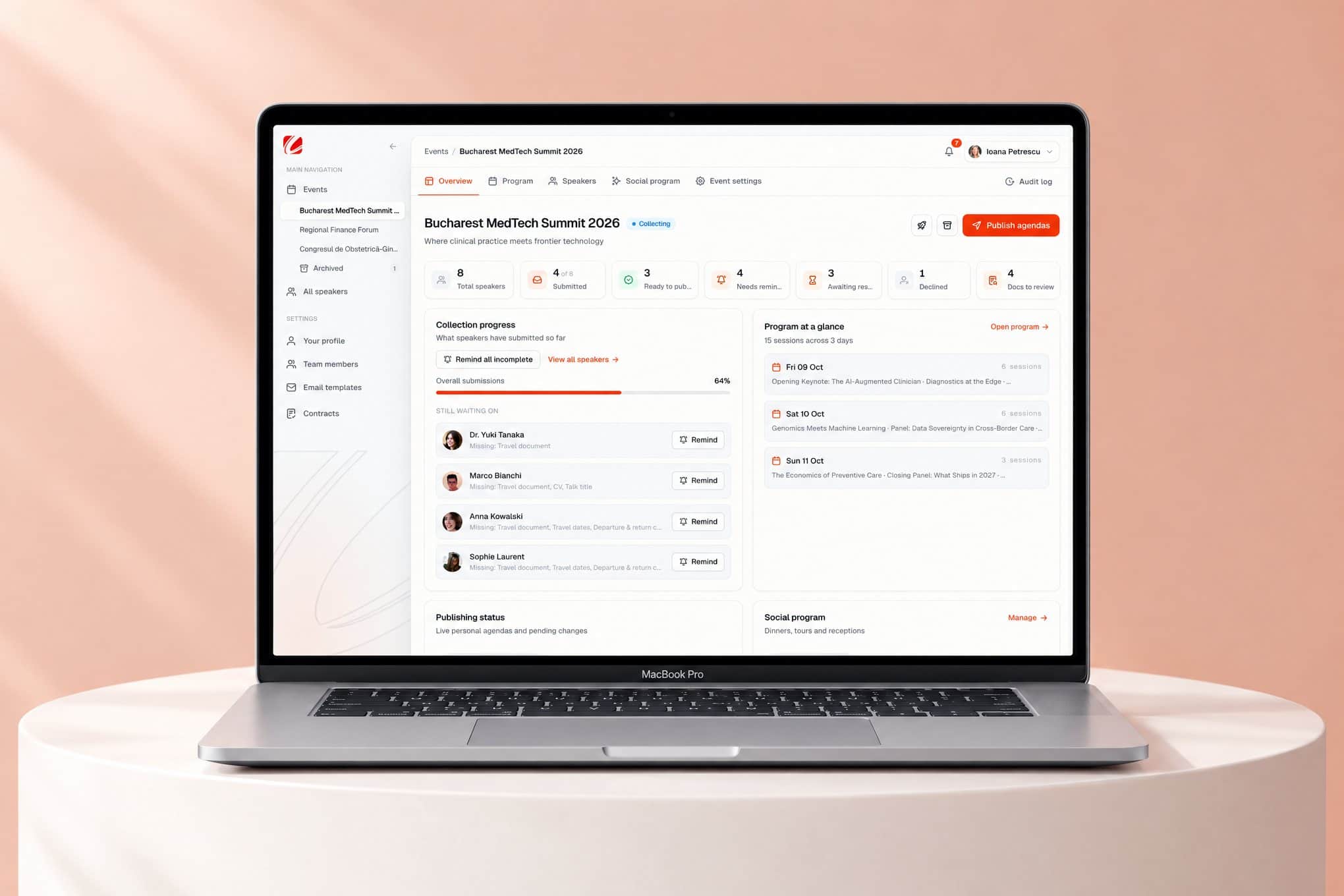
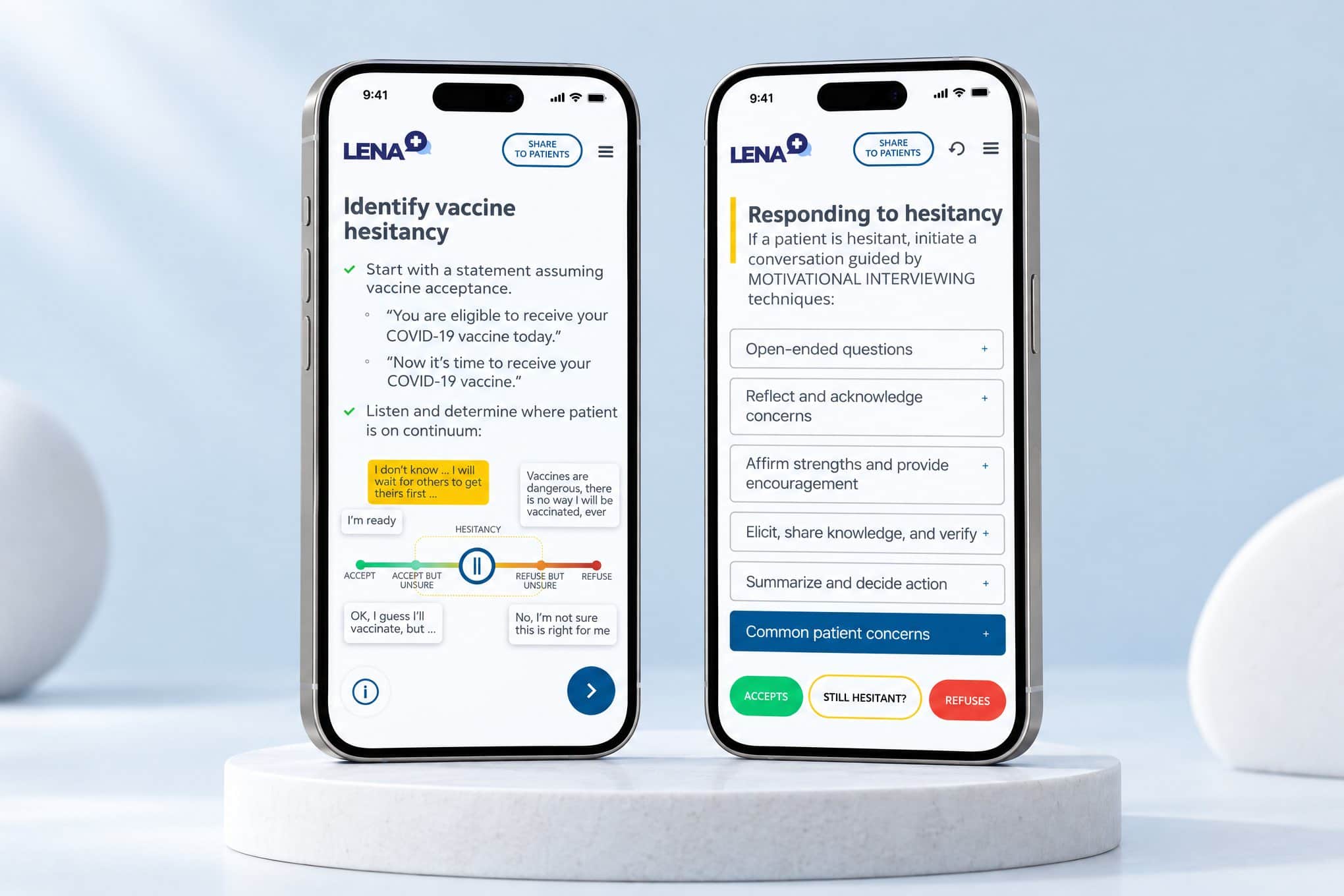
For the World Health Organization, in partnership with Hungry Bytes and together with a family doctor, we built WHO LENA: a mobile app that guides doctors through sensitive conversations with patients, on the App Store since June 2021. We say plainly what it is: a content app for doctors, with no accounts, that does not collect or process patient data. It shows that we work well with doctors and with a health organization, not that we have already built a system that handles medical data.
The rehabilitation center example above is illustrative. We publish a real project's figures only with the client's approval.
How we start
We start with the diagnosis.
The diagnosis is the first step of every Murarum project. For a clinic, it means we follow a few dozen real appointments, from the patient's first call to the invoice and the reporting, and write down what is worth changing first. We write no code during the diagnosis.
What you get
- A map of how an appointment travels today, per channel: phone, website, Facebook, WhatsApp, front desk.
- Baseline figures measured at your clinic: appointments per channel, no-shows, time on the phone, details entered twice.
- A ranked list of changes, with the reasoning for each. For example, reminders and rescheduling from the message before the patient journey, or the other way around.
- A written plan, with a proposal if you want us to build it. The diagnosis is yours, and you can act on it without us. If an off-the-shelf booking tool fits you, we write that down.
What we need from you
- A few hours with reception and with one doctor or therapist.
- Access to the practice software, or an export, and to the channels appointments come in through.
- We don't need patient data for the diagnosis: we work on exports without identifying details and on screens, alongside your team.
- One person who can say yes or no.
How long it takes
From a few days to 2 weeks, depending on how many locations, specialties and programs we look at. If your clinic is in Moldova, north-eastern Romania, we come to your premises for the diagnosis.
If you already know what you want to build
The diagnosis gets shorter, for example 2-3 days on a single flow: online booking with reminders, or session packages, with the connection to your practice software.
"Almost a third of appointments are moved or cancelled by phone. We start with reminders and rescheduling from the message, and leave the patient journey for phase two."
Questions about digital transformation for healthcare clinics
Why not a booking SaaS on a monthly subscription?
Sometimes a booking SaaS is the right choice, and we'll tell you so in the diagnosis. If you have a single practice, a few doctors and only want patients to pick a slot and get reminders, a monthly subscription does the job for less than a custom application. We build custom software when the clinic doesn't fit the template: several locations on a shared calendar, session packages and subscriptions, a long journey with steps and documents, occupational health requests from employers, or a connection to your practice software that the SaaS doesn't offer. Then the application and the code belong to the clinic, with no license per doctor or per appointment. We compare the cost over several years, not just the cost to start.
Freelancer, Agency, SaaS or Studio?How do you handle patient data?
Health data is a special category of personal data under Article 9 of the GDPR, so we treat it that way from the first day of the project. The clinic remains the data controller, and we act as its processor, under a data processing agreement signed before we have access to anything. Data is hosted in EU data centers. Access is limited to the people who need it, and every access is logged. We carry out the data protection impact assessment (DPIA) together with the clinic, before launch. Of the patients' data we see only what the project needs, and in the diagnosis we work on data without identifying details. We don't give legal advice: if the clinic has a data protection officer (DPO), we work with them from the diagnosis on.
Can you connect the application to our practice or lab software?
Yes, if the software has a way in: an API, file imports and exports, or database access. We connect to it the way we connect to an ERP. Tell us which software you use and we'll tell you in the first conversation which kind of connection it supports. If the vendor has to open up access, we talk to them together with you. We check the technical details in the diagnosis, on your system.
ERP-CRM IntegrationDoes it work for services covered by CAS?
Yes. Online booking can keep services contracted with CAS, the Romanian health insurance house, apart from paid ones, and the patient uploads the referral when booking so reception can check it before the visit. Reporting to CAS stays in the program that does it today; we make sure the appointment data reaches it without anyone entering it a second time. How the connection to your program works, we check in the diagnosis.
Do we have to rebuild our website?
No. Online booking and the patient account are added to the site you have, or live at a separate address linked from it. If the booking button on your site leads nowhere today, that's where we start: we connect it to the shared calendar.
How long does it take and how much does it cost?
The diagnosis takes from a few days to 2 weeks. We put the build timeline in the proposal after the diagnosis, depending on how many locations, services and integrations it covers. We don't publish a price list: the price of the diagnosis is agreed in writing before we start, and the build has a fixed price for clearly defined work. We ship in stages: one part reaches patients before we start the next.
How We PriceWho owns what you build?
The clinic does. The code, the repository and the documentation are yours from the first commit, with no license and no dependence on us. Any bug that appears after launch is covered by a 12-month warranty.
Do you work with clinics in Iași?
Yes. We are based in Iași, Romania, and work with companies across Romania and the European Union. For clinics in Moldova, north-eastern Romania, we come to your premises for the diagnosis, front desk included, where the appointments are taken. The rest of the work usually runs remotely.
Other industries
The same method, in other sectors.

Tell us how an appointment gets from a patient into your calendar today.
How many locations you have, which channels appointments come through and who enters them.
We reply within two working days and tell you whether a diagnosis makes sense and what it would cover. We usually work with clinics of 10 to 250 people. How many locations, specialties and programs you run matters more than your headcount.