Manufacturing
Digital tools for manufacturers,
from quote to production
Quote requests arrive by phone, email and WhatsApp, without complete dimensions. Someone prices each one by hand, including for customers who never come back. We build the apps your customers use to request quotes and order on their own, then connect each order to your ERP and your production order.
For manufacturers, Murarum builds two things that connect. The first is what your customers see: a price calculator for your products, B2B ordering with each customer's prices, file upload and proof approval, reorders from history and order status. The second is what happens behind it: an accepted order becomes a production order, material requirements come from your recipes and bills of materials, and the invoice goes out from the same data. You keep your ERP. We are based in Iași, Romania, and we start with a short diagnosis.
We reply within two working days. The first conversation is about how quote requests reach you today, not about technology.
Sound familiar?
The day quote requests eat up your office.
Situations we hear from makers of packaging, labels, windows and doors, building materials, furniture and food. If two of them sound like you, it is worth a conversation.
Every price is worked out by hand.
Box dimensions, board grade, run length, print. Or width, height, profile and glazing. Someone in the office prices every request, including the ones that never turn into orders.
Requests arrive incomplete.
Dimensions read out over the phone, a photo on WhatsApp, "roughly how much would this be?". Then three calls to find out what the customer wants, and a quote redone twice.
Artwork gets approved in an email thread.
The customer's file, the corrections, another version, the final sign-off. On a reorder the whole thread starts again, even though the label is identical to last month's.
Repeat customers still order by phone.
Contractors, resellers, joiners and shops order the same products every month. The order goes on paper and into the system once the phone goes quiet.
Cutting lists get retyped.
A joiner sends a spreadsheet, a PDF or a photo. Someone keys it into the panel optimization software, checks the edge banding on every side, and a mistake only shows up at the saw.
Pre-orders get lost between shop and kitchen.
Cakes, platters and orders from shops and distributors come in on several phone numbers and reach production on paper. A wrong date or inscription only shows up at pickup.
Spreadsheets and WhatsApp are nothing to be embarrassed about. They are the starting point: they show us what your customers ask and how you work out a price.
Quoting and ordering
Customers request quotes and order on their own.
Your team checks.
Everything below starts from your own pricing and production rules, not from a template. The estimated price follows your formulas, and your sales person still confirms the final quote where it is needed. Each component can be built on its own.
A price calculator (or product configurator) is a page where a customer picks dimensions, material, quantity and options, sees an estimated price right away and sends a complete request. The price comes from the company's own rules: price lists, material costs, run-length breaks and surcharges.
- 01
A price calculator for your products.
The customer picks dimensions, material, quantity and finishes and sees an estimated price based on your rules. The request reaches sales complete, with everything you need to confirm it. Combinations you do not make cannot be selected.
- 02
Structured quote requests.
For products that cannot be priced on the spot: a form that asks for exactly what you need (dimensions, sketch, photos, deadline) instead of "send us a message". Requests land in one list, not in three inboxes.
- 03
File upload and proof approval.
The customer uploads the print file or the cutting list, sees what you prepared and approves it or asks for changes in the same place. Every version is kept, with the date and the name of whoever approved it.
- 04
B2B accounts with each customer's prices.
Contractors, resellers and distributors see the prices agreed with them and the catalog that applies to them, without asking for a price list by email.
- 05
Reorders from history.
The customer repeats last month's order, an approved label or a saved cutting list in one click. Your team does not restart the thread.
- 06
Order status.
The customer sees whether the quote is confirmed, the order is in production or the goods are ready, without calling.
- 07
Pre-orders with a pickup date.
For food production: the cake, the platter or the shop's order, with the date, pickup point and details written once and sent straight to the kitchen or bakery floor.
- 08
Online payment or a deposit.
Where you sell directly, the customer can pay for the order online or leave a deposit for a pre-order, in the same app.
The app can run in Romanian and in your customers' languages. For exporters, partners in France or Italy can request a quote in their own language.
Inside the company
An accepted order moves on without anyone retyping it.
The back office is covered in detail on the manufacturing automation page. In short, this is what connects to the order that comes from your customer.
Today and after
A quote request for windows, from the phone to the shop floor.
An example written for this page: a PVC and aluminum window and door maker with about 50 people, which receives around 300 quote requests a month and turns about 60 of them into orders. The figures are working assumptions, not a client's results.
Illustrative example
Today
The request arrives by phone or WhatsApp. By hand
Dimensions read out, a photo, sometimes without the profile or glazing type.
The sales person chases the missing details. By hand
Another call, another message.
The price is worked out in quoting software or a spreadsheet. By hand
In the example: 25 minutes per request.
The quote is redone when the customer changes something. By hand
One more window, different glass, another color. In the example: one 10-minute recalculation per request.
The accepted order is rewritten as a production order. By hand
With the cutting dimensions, by hand. In the example: 15 minutes per order.
Five manual steps. Measurement errors show up on the shop floor, not at the sale.
After
The customer enters dimensions and options. The app
In the calculator on your site, with the profiles, glazing and colors you actually make.
An estimated price appears right away. The app
Calculated with your pricing rules. The request reaches sales complete.
The sales person checks and confirms the quote. Team checks
In the example: 5 minutes per request. Special cases reach them with the reason written down.
The customer edits the request. The app
The price recalculates, and the sales person sees what changed.
The accepted order becomes a production order. Team checks
With the same dimensions, sent on to the production software. The planner checks it.
One sales step stays with a person: the confirmation. Dimensions are written once, by the customer.
What this means in a month, in working time
The same illustrative example, counted over one month.
| Task, per month | Before | After |
|---|---|---|
| Pricing quotes: 300 × 25 min; after: 300 × 5 min of checking | 125 h | 25 h |
| Recalculations: 300 × 10 min; after: exceptions only, assumed 5 h | 50 h | 5 h |
| Production orders: 60 × 15 min; after: 60 × 3 min of checking | 15 h | 3 h |
| Total, in 8-hour working days: ≈ 190 h vs ≈ 33 h | ≈ 24 days | ≈ 4 days |
An illustrative calculation with our own assumptions. Real values depend on how many requests you get, how complex your products are and how often a quote changes. We measure them in the diagnosis, on your own requests, before we build anything. The example leaves out the orders won by answering first and the measurement errors caught before production.
The same pattern in other kinds of production (illustrative examples)
Corrugated packaging
Box dimensions, board grade and run length give an estimated price. A reorder repeats last month's box.
Labels and print
The customer uploads the file, sees the proof and signs it off in the app. A reorder starts from the approved label.
Panel cutting and edge banding
The joiner uploads the cutting list. Parts larger than the board or missing edge banding are flagged before the list reaches the optimization software.
Paving and building materials
Contractors and resellers see the catalog with their prices and availability by product line, then send the order without calling.
Food production
Customer pre-orders and daily shop orders reach the production floor by day and by pickup point. Delivered products stay linked to their batch.
What you already have
You keep your ERP.
We connect to it.
Your ERP or inventory system stays the source
For stock, prices and invoicing. We connect through an API, database access or scheduled imports. We replace it only if it cannot be connected at all, and that decision is made in the diagnosis, with the cost of both options on the table.
Your production software stays
Panel optimization, window and door quoting or prepress software receives data in the format it accepts, instead of someone retyping it.
Your website and online store stay
The calculator or B2B account is added to the site you have, or runs at a separate address linked from it. You do not need a new website to start.
Spreadsheets and WhatsApp are the starting point
The spreadsheets you price with today show us the rules. The WhatsApp messages show us what customers ask. We build the calculator and the form from them. The phone stays for customers who prefer to call, but their order is also entered only once.
You do not need an IT team
We build, release to production and hand over. You need one person who knows the pricing rules and a few hours from the people who write quotes today.
Case study
The same pattern, built and running in production: Eventer.NET.
Eventer.NET, a company based in Iași, organizes medical congresses; it does not make packaging. We still chose this project, because the mechanism is the one a manufacturer needs: people outside the company fill in their own details and documents, the team checks from one place, and status is visible at a glance.
We started from how the team actually worked, built an interactive prototype on demo data and walked through it with the team before writing the backend. After sign-off we built the platform: UX and UI design, frontend, backend and API, release to production and QA. The platform runs in production and the Eventer.NET team uses it.
How it translates
| At Eventer.NET | At a manufacturer |
|---|---|
| Speakers fill in their own travel, accommodation and documents, in Romanian or English | Customers fill in their own dimensions, options and files, in their language |
| The team checks what came in from one back office, instead of collecting and copying | Sales and prepress check the request instead of piecing it together from phone calls |
| Each speaker's agenda follows the program when it changes | Order status and the production order follow the order when it changes |
| Organizers see at a glance who still owes something | You see at a glance which quotes await confirmation and which proofs await approval |
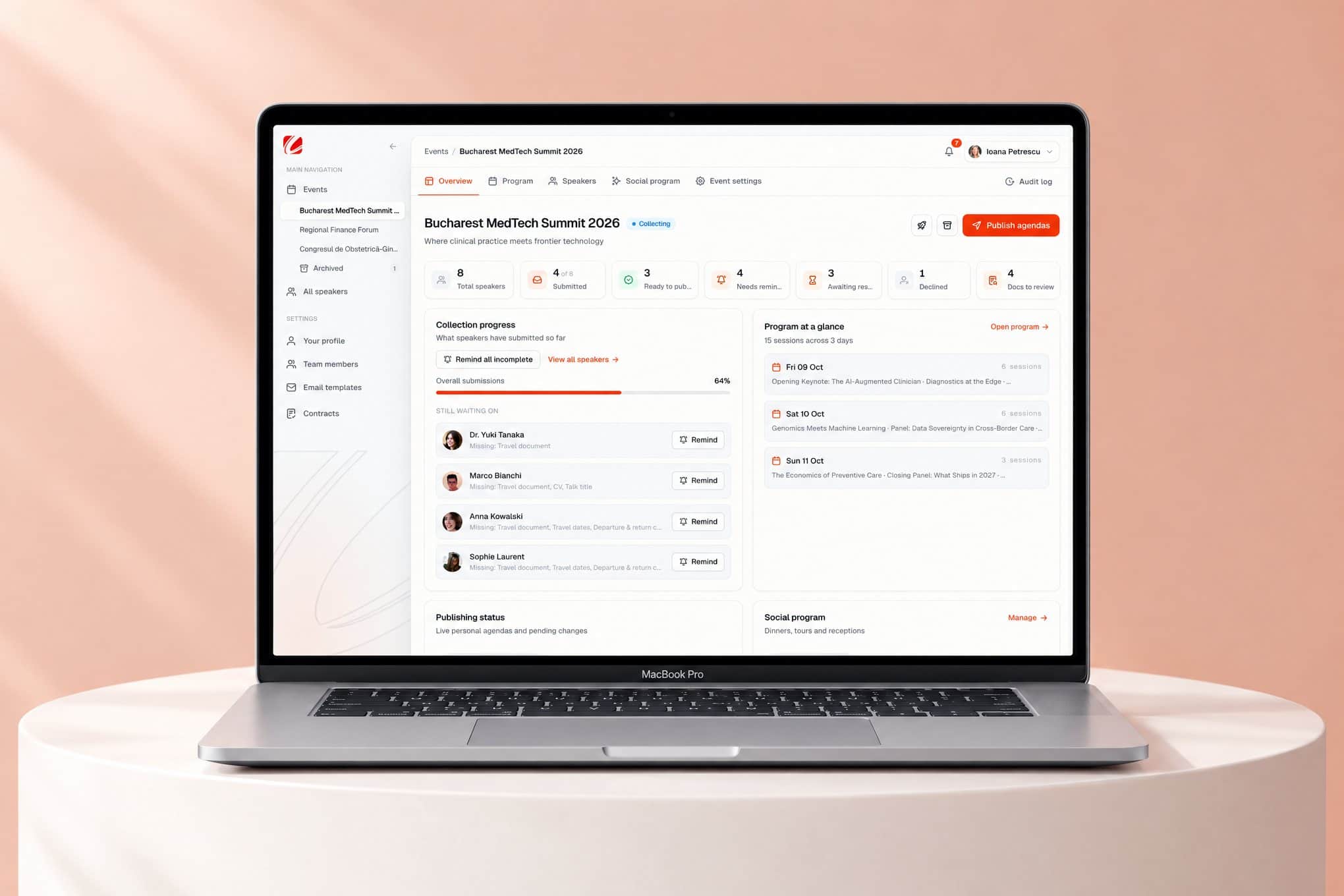
We do not yet have a published case study from a factory. The window example above is illustrative. We publish a real project's figures only with the client's approval.
How we start
We start with a diagnosis, on your real quote requests.
The diagnosis is the stage every engagement with Murarum starts with: we look at how a request moves through your company, from the customer's first message to the production order, before we build anything. The price and the scope are agreed in writing before we start.
What we do and what you get
- We follow a few real quote requests, from phone, email or WhatsApp to the ERP order and the production order.
- We write down the rules you price by today: materials, dimensions, run lengths, surcharges, exceptions.
- We measure how many requests you get, how long a quote takes and how many get redone.
- We check how your ERP and production software can be connected.
- You get a written diagnosis that stays yours: the map from request to production, the baseline figures, your pricing rules on paper, the changes ranked by value and, if you want us to build, a fixed-price proposal. If off-the-shelf software fits better, we write that down.
What we need from you
- A few hours from the people who write quotes today.
- The spreadsheets or software you price with.
- Access to the ERP.
- One person who can say yes or no.
How long it takes
From a few days to 2 weeks, depending on how many products and teams are in scope. If your company is in Moldova, north-eastern Romania, we come to your site, including the shop floor where the paperwork gets filled in.
If you already know what you want to build
The diagnosis gets shorter, for example 2-3 days on a single flow: the pricing rules for the calculator and the ERP connection, not the whole company.
We do not write grant applications. If you already have funding, the plan from the diagnosis can serve as the technical basis.
Digitalization With or Without PNRRQuestions about digital tools for manufacturers
Can you build a price calculator for our products?
Yes, if your pricing follows rules that can be written down: dimensions, materials, run lengths, breaks, surcharges. We put them on paper in the diagnosis, starting from the spreadsheets or software you price with today. Where a price cannot be calculated on the spot, we build a structured quote request that reaches sales complete. The price shown is an estimate, and your sales person confirms the final quote where needed.
Do we have to replace our ERP or production software?
Usually not. If your ERP has an API, accepts imports or allows database access, we keep it, and it stays the source for stock, prices and invoicing. Likewise, panel optimization or quoting software receives data in the format it accepts. We replace a system only if it cannot be connected at all, and that is decided in the diagnosis.
ERP-CRM IntegrationDo we need a new website or online store?
No. The calculator, B2B account or proof portal is added to the site you have, or runs at a separate address linked from it. If your current online store already has a product customization step, we often start from it and make it calculate the price.
Why not off-the-shelf software?
Sometimes off-the-shelf software is the right choice, and we tell you so in the diagnosis. A custom app makes sense when the pricing rules are your own, when it has to connect to the ERP and production software you already run, or when your customers need to see their own history, prices and proofs. We compare the cost over several years, not just the cost to start.
Freelancer, agency, SaaS or studio?How long does it take and what does it cost?
The diagnosis takes from a few days to 2 weeks. We put the build timeline in the proposal after the diagnosis, depending on how many products and integrations it covers. We do not publish a price list: the diagnosis price is agreed in writing before we start, and the build has a fixed price based on the diagnosis plan.
How We PriceWho owns the code?
You do, from the first commit. The code, documentation and hosting and provider accounts are in your name, so you do not depend on us. Bugs found after launch are covered by a 12-month warranty.
Are our customers' files and data safe?
Yes. Access to files, proofs and prices is limited to the people who need it, and data is stored on your servers or in the cloud, in EU data centers. We sign a mutual NDA before we see anything and a data processing agreement for any data we can access. For brands that require it, each customer sees only their own files.
Do you work with companies in Iași? Can you visit us?
Yes. We are based in Iași and work with companies across Romania and the EU. For companies in Moldova, north-eastern Romania, we come to your site for the diagnosis, including the shop floor where the paperwork gets filled in. The rest of the project usually runs remotely, on Romanian time.
Other industries
The same method, in other sectors.

Tell us how a quote request reaches you today.
Briefly describe what you make, which channels requests arrive on and who works out the price.
We reply within two working days and tell you honestly whether a diagnosis is worth it and what it would cover. We usually work with manufacturers of 10 to 250 people. How complex your quoting and ordering are matters more than your headcount.